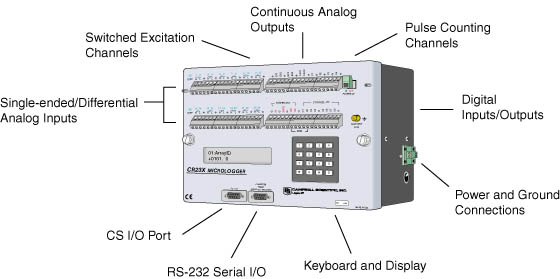
Analog
inputs can be configured to make single-ended (a
voltage measurement compared to ground) or differential measurements
(the "high side" of a voltage output compared to the "low
side"). Voltages must fall within the input voltage range
of the datalogger. Software selectable voltage ranges let you
take full advantage of the datalogger's resolution to measure
voltage changes as small as 50 nV.
CSI
loggers provide switched excitations for
resistive bridge measurements. Bridge measurements are the ratio of the
bridge output to the excitation voltage, eliminating any errors in the
excitation voltage. Several instructions are also capable of measuring
the voltage loss due to the resistance in sensor leads, thereby reducing
another source of error. Our excitation channels can be programmed to
the level of excitation required for each measurement, and switched on
and off under program control.
Continuous
Analog Outputs provide programmable voltage levels,
at low amperages, to strip chart recorders or proportional controllers.
Pulse
counting channels measure switch closures, low level
ac sine waves, or high frequency pulses. They sum the number
of counts over each execution interval, or scan rate, and allow
the determination of variables such as rpm, velocity, flow, and
rainfall intensity.
Digital
I/O ports can be configured independently within
the datalogger's program as either inputs or outputs. They can
issue control signals and are also used with a variety of "smart
sensors" that output digital rather than analog signals.
Power
and Ground inputs allow easy connection of an energy
source, typically 12 Vdc nominal, to energize the datalogger.
These can be dc powered through batteries and a solar panel or
ac powered through a standard wall socket.
Keyboard/Display allows
manual initiation of data transfer and display sensor readings, stored
values, or flag/port status. Some of our loggers, such as the CR23X and
CR5000, have this built in, while the CR510 and CR10X have a portable
one, the CR10KD, that can be carried from site to site in a datalogger
network.
Communication
ports are the RS-232 or CS I/O ports. The CS I/O
port is for connecting data transfer and storage peripherals
such as phone, RF, or short haul modems, or for connecting directly
to a computer serial port via an SC32A. If the datalogger has
a port that's labeled RS-232, it is used to connect the datalogger
to the computer's serial port directly.